本帖最后由 eloney 于 2010-3-31 17:41 编辑
本人归纳的全鬼故事扩展
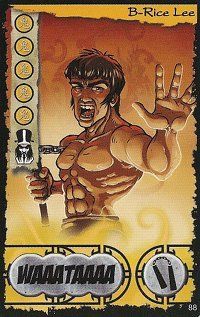
1.B-Rice Lee Essen 2009 Promo
Description
This promo card for Ghost Stories is being handed out at Essen 2009 at the Repos Production booth. B-Rice is a 5-yellow tao Wu Feng incarnation, who has the ability "WAAATAAAA" icon for when it enters play and during the Yin phase. It also has a Nun chuck icon when it leaves play.
B-Rice Lee (Wu-Feng)Toughness: 5 yellow
WAAATAAA: when B-Rice Lee arrives in play he's doing the death-cry frightening the most powerfull taoists. Active player rolls 4 tao dices. For each Black or Yellow, a player must loose 1 Qi. Lost Qi can be split between players and neutral boards, player's agree who's loosing Qi. If players can't agree, each player and each neutral board losses 1 Qi (total 4).
B-Rice's Nunchaku: A taoist killing B-Rice Lee does not discard the B-Rice card but keep it in front of him and he will be able to use the B-Rice nunchaku on his coming rounds. Nunchaku is a single use Artefact, it allows his owner to succeed in an exorcism without rolling dice or spending tao tokens (but he can't kill a Wu-Feng incarnation). Once Artefact is used, B-Rice is discarded. It's not possible to use it after rolling dice, you must choose to use it at the beginning of your exorcism. Be careful, the killed ghost right stone is still active (reward/curse)!
2.苍月预定扩展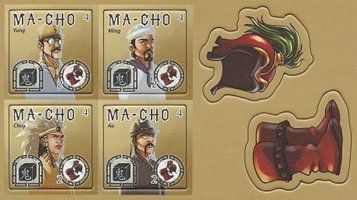
Description
This expansion is currently only available to those who pre-order the Ghost Stories: White Moon expansion from Repos Production for pick-up at Essen 2009.
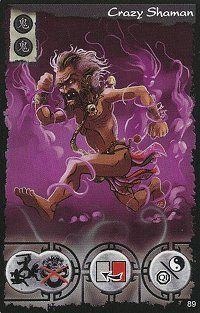
This expansion includes one ghost called the 'Crazy Shaman' and 4 new villager tiles above and beyond what's included with the White Moon expansion.
SetupThe 4 members of the Ma-Cho family replace 4 villagers from the White Moon expansion.The players remove either:
•one Member out of 4 different families•two members out of 2 different "2 members families" (determined randomly)•three members out of a "3 members family" and one member out of a different "one member family" (determined randomly)
Thus there are always 24 villagers in play at the beginning of the game. The game proceeds as described in the White Moon rules.
CurseEach time one of the 4 members of the Ma-Cho family is killed, the active player must roll the Curse die and suffer its effects.If the haunting side is rolled, the tile where the Ma-Cho family member was killed is the tile affected.
RewardThe Ma-Cho family works in a slightly different way from the families in White Moon:
•if any two of the four Ma-Cho members are saved, the active player gains one of the two associated artifacts. The player must pick either the Boots or the Helmet.•if the other two Ma-Cho are saved, the active player then gains the second Artifact.
Note: both Ma-Cho Artifacts are subject to the same rules as those from White Moon (inheritance rules).
Boots of the Ma-ChoThe taoist with the Boots can perform his movement AFTER his action. He can therefore take a tile action, get a villager to safety, or perform an exorcism THEN move in the village. This effect is optional - the owner of the Boots is free to perform its movement BEFORE or AFTER its action. Only one movement is allowed (it is not possible to move both before and after one's action, even for the Red Taoist with the "Dance of the peaks" power).
Helm of the Ma-ChoThe Taoist with the Helm gains a moon crystal each time he suffers a negative effect from the Curse die (loss of a Qi point, haunting a tile, loss of Tao tokens, ghost coming into play). The Helm has no effect on the blank faces of the Curse die. If there are no moon crystals in the reserve, the Helm of Ma-Cho has no effect.
Crazy ShamanThe Crazy Shaman is an additional ghost. If you wish to face him, add his card to the ghosts and remove an extra one randomly before preparing the draw pile.Resistance: 2 (black)Left Stone: as soon as he comes into play, this Ghost prevents the use of all Taoist powers (use the Inactive Power markers).Central Stone: at the beginning of each of the Yin Phases of the board he is (Taoist or Neutral board), this Ghost moves clockwise to the next free Ghost space. If there are no free spaces, it does not move.Right Stone: when this Ghost is exorcised, the active player gains 1 Qi OR 1 Yin-Yang.
3.愚人节扩展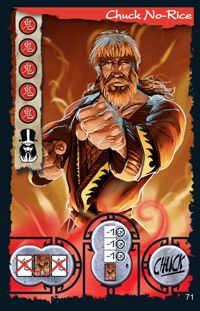
Description
Originally available as a PDF download from the Repos Productions website as an April Fool Joke, this promo card for Ghost Stories was handed out at GenCon 2009 at the Asmodee booth. Chuck is a 5-red tao Wu Feng incarnation, who kills adjacent ghosts when he comes into play, removes one Qi from each monk in the column in front of him each activation, and provide no reward, other than his signature.
4.哨所扩展(也就是塑料袋扩展)
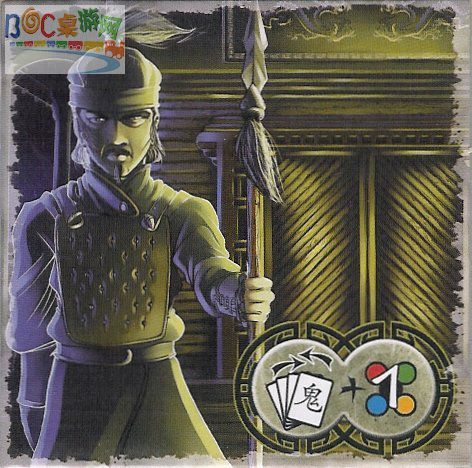
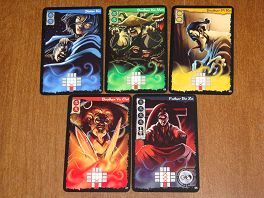
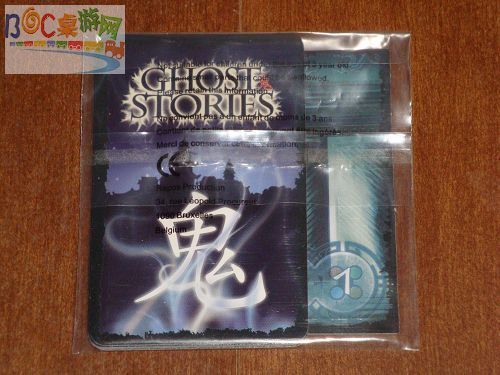
I obtained this mini-expansion directly from spielbox (very easy transaction, prompt mailing--there's no reason for US gamers to avoid this), and overall I'm glad I did. Briefly, this adds a new village tile that lets you rearrange the top four ghost cards to your liking, and grants a Tao token.
It also adds five new ghosts, four "normal" and one Wu-Feng, that have the effect of "blocking" the village tile in front of them (the tile's effect can't be used, nor can it be un-haunted).
I've played six solo games with it now, all on Hell, two wins, one close loss, three bad losses, and I like most of what it does. Some pluses and minuses:
Positives
Increased variety/variability: The deck order is always going to present this, but this tweaks it a bit further, so you really don't know if the dreaded Black Widow will show up, etc.
Replacement effect: Along those lines, removal of a village tile can create a very different board and shake up set approaches.
New effects: The shutdown of a tile's function can be either pointless or annoying (and rarely, critical), but either way, it's just nice to have another effect. Also, if you play fast and loose with haunted village tiles, these can be nasty.
Forward planning: The Guardhouse's effect allows you to mitigate the randomness to some extent, which is welcome.
No more Cemetery: Cemetery is pointless in solo, and nearly so in multiplayer. I should note that this review was predicated on playing solo and removing the Cemetery (as I dislike useless appendages in games), but that is a variant approach, and makes the game easier. Random removal is the official rule, and shakes things up considerably.
Negatives
Guardhouse has no downside: It's always a good "default" choice, and can easily blunt a nasty run. Think about how often simply flipping the order of the next two ghosts would have really helped you, let alone the next four. And a Tao token?
Wu-Feng is weak: He's black, so you tend to be prepared for him (by default, you should assume you'll face a black Wu-Feng, and with the Guardhouse, you may know); his effect isn't strong unless the game is already way out of hand; and he can be left alone for a while.
Weak ghost effect: They only shut down the tile in front of them, instead of the active tile in front of them; huge difference, and allows you to use a haunted tile as a sop (yes, it's harder to un-haunt, but...again, not hard to mitigate).
Deck dilution: Related to the above, because this effect isn't that strong, it exacerbates the effect of slightly fewer Haunters and other nasties appearing.
Thinner card stock: Don't know if this is true for all editions (I have the English/US version of the base game), but I can tell the difference, even when I'm shuffling, let alone drawing. Because you manually build the deck, it's relevant, especially when it comes to the Wu-Feng card insertion.
Law of Fives: There should be a black "normal" ghost! Everything in this game is built around the five colors, and building the deck in multiples of five. Yes, Wu-Feng is a black ghost, but that's not the same. Now you have a dissonant "discard four more" clause, plus the black ghosts are the most interesting, with even more varied effects and rewards. Yes, a trivial "negative," but hey, it's my post.
In isolation, the Guardhouse makes the game easier, as it's a strong tile (perhaps the strongest). The new ghosts are easier, and the impact of diluting runs of the tougher ghosts is noticeable. This, then, provides some offset for the increased difficulty should a "critical" tile be removed (Sorceror, Pavilion, Buddhist Temple).
On the whole, I think the game is slightly better with the expansion, but I prize variety very greatly. I suspect that you'll really like this expansion if you think the game is too hard, or not variable enough, as you can tune things more to your liking.
(Edited after further thought and some great feedback from user Eeeville, and several more games to revise my initial conclusions.)